

Category: Uncategorized

  • AI Takes a Village — and a Tech Stack (and Someone to Run It)
    AI Takes a Village — and a Tech Stack (and Someone to Run It)

    Steven Palange

    CAO CIO CSO & CISSP | Thought Leader | AI Integration & Governance Advisor to CIOs, CISOs, and CFOs Specialist in AI ROI, Risk, Compliance, and AI-Ready

    Written by Steven Palange, CAO, CIO, CSO, & CISSP | Thought Leader | Helping CXOs & IT Leaders Solve Automation, AI, Cybersecurity, and Cloud with Proven, Scalable Solutions. E:steven_palange@tlic.com P: 401-214-5557

    Special Section: Infographics, Video, & Audio Learning Guide that summarizes this Newsletter Article for Busy Professionals

    🔊Listen to the Strategy Podcast

    🎥Watch the Executive Briefing (Video)

    Most organizations are not behind on AI anymore.

    They’re overloaded.

    Copilot is deployed. ChatGPT is approved. SaaS platforms quietly added AI features. Power users are experimenting beyond policy.

    On paper, adoption looks healthy.

    In reality, the pattern looks different:

    • Productivity gains are inconsistent

    • Risk is rising quietly

    • Costs are creeping upward

    • Accountability is unclear

    And leadership keeps asking the same question:

    “What AI are we actually running — and who owns it?”

    AI rarely fails because of missing tools. It fails because there is no foundation, no integration, and no operator model.

    AI takes a village — and a stack — and people who can run both.

    The Layer Most Companies Underestimate: Hardware

    AI exposes weak infrastructure immediately.

    Standard endpoints struggle once AI features are embedded across daily applications. Performance drops. Friction rises. Adoption slows.

    But the bigger mistake is treating all users the same.

    In practice, organizations have at least two AI user classes:

    Standard users

    • Need modern, responsive endpoints

    • Optimized for AI-enabled SaaS

    • Stable, secure, supportable

    Power users

    • Need high memory ceilings

    • GPU capability

    • Fast local storage

    • Systems built for automation, experimentation, and AI-assisted workflows

    When power users are constrained by hardware, AI becomes theoretical instead of operational.

    The Next Reality: Your SaaS Stack Is Becoming Your AI Stack

    Most companies haven’t fully internalized this yet.

    CRM, ERP, HR, finance, support, and marketing platforms now include embedded AI and expanding data exchange paths.

    Without intentional design, this creates:

    • Fragmented AI outputsDuplicate prompts and workflows
    • No shared learning

    • No governance trail

    AI efficiency doesn’t come from adding more tools.

    It comes from making the existing stack work together — intentionally.

    That requires:

    • SaaS rationalization

    • AI feature mapping

    • Integration design

    • Data path awareness

    Before “Advanced AI,” the Basics Must Exist

    Every successful AI program starts with uncomfortable clarity:

    • Who is using AI today?

    • Which tools — approved or not?

    • For what business outcomes?

    • With which data sources?

    That leads to foundational controls:

    • Shadow AI discovery

    • AI usage visibility

    • Prompt libraries

    • Governed data access

    • Vector knowledge layers

    Only after this foundation exists does the deeper AI stack make sense:

    • Data layer

    • Model selection and tuning

    • Inference platforms

    • Orchestration and agent layers

    • Workflow-embedded AI applications

    Skipping these steps doesn’t accelerate AI.

    It amplifies risk.

    The Part Most Vendors Avoid: Ongoing AI Operations

    Here’s the operational truth:

    AI that isn’t monitored becomes:

    • Inconsistent

    • Expensive

    • Risky

    • Eventually ignored

    AI is not a feature rollout.

    It’s a living system.

    It requires:

    • Usage monitoring

    • Prompt and workflow management

    • Data access control

    • Cost tracking

    • Performance measurement

    • Continuous adjustment

    Not quarterly. Continuously.

    A Real-World Pattern That Works

    Organizations seeing real AI gains tend to follow a similar path:

    They segment users by AI workload.

    They upgrade endpoints accordingly. They rationalize SaaS tools before adding more.

    They discover Shadow AI instead of pretending it doesn’t exist. They centralize prompts and knowledge sources.

    They govern model and data usage. They monitor AI like production infrastructure.

    The result is not “AI magic.”

    It’s AI that is measurable, governable, and useful.

    Three Questions Worth Asking

    Do your power users have hardware that enables AI — or quietly blocks it?

    Can you see, in one place, which AI tools are running across your organization today?

    If AI usage doubled tomorrow, would your stack scale — or spiral?

    Closing Thought

    The organizations getting real value from AI didn’t just buy smarter tools.

    They built the right foundation. They integrated the right stack. They put operators behind it.

    That’s what AI maturity actually looks like.

    ✅ Cybersecurity trends

    ✅ AI transformation

    ✅ IT strategy for Banking, Financial Services, and Healthcare

  • Why AI CX Agents Are the Fastest Path to Revenue, Efficiency, and Modernization
    Why AI CX Agents Are the Fastest Path to Revenue, Efficiency, and Modernization

    Steven Palange

    CAO CIO CSO & CISSP | Thought Leader | AI Integration & Governance Advisor to CIOs, CISOs, and CFOs Specialist in AI ROI, Risk, Compliance, and AI-Ready

    📑Interactive Resources & Visual Insights

    To make this strategy as practical as possible, here are resources you can explore directly:

    🎧Listen to the Strategy Podcast (SoundCloud)

    🎥Watch the Executive Briefing (Video)

    A 2-minute overview on why AI-driven modernization is critical for Urschel and how competitors are already setting new benchmarks.

    Every CEO and CFO wants three things: more revenue, lower costs, and happier customers. AI CX Chatbots and VoiceBots trained on your proprietary data — CRM notes, policies, SOPs, product documentation, and more — deliver all three.

    But here’s the catch: the AI is only as good as the team deploying, integrating, and maintaining it. That’s where Soveraign Solutions comes in. We are more than a vendor; we are your full IT, Security, and AI Integration team, replacing 3–5 internal roles for a fraction of the cost — starting at just 20 hours/month for $400.

    Instant ROI from Day One

    An AI CX Agent is more than a digital assistant — it’s a 24/7 sales and support powerhouse:

    • 24/7 availability: No abandoned sessions, no frustrated prospects, no missed opportunities

    • Higher conversions: 20–40% more new customers

    • Support cost reduction: 30–50% savings

    • Staff replacement: Replaces multiple full-time roles

    Your homepage becomes a round-the-clock sales rep, answering questions, booking qualified meetings, and updating Salesforce or HubSpot automatically. Meanwhile, your team focuses on high-value, revenue-driving tasks, while the AI handles repetitive tickets, FAQs, and scheduling.

    Accuracy That Builds Confidence

    Unlike generic AI or chatbot vendors, our AI CX Agents are trained on your proprietary data, ensuring:

    • Accurate answers: Policies, products, pricing, SOPs, CRM notes

    • Compliance: Reduces errors and prevents regulatory issues

    • Consistency: Every interaction reinforces trust with customers

    Real-Time Intelligence & Insights

    Every interaction with your AI CX Agent generates actionable insights:

    • Customer intent: What products or services they are most interested in

    • Friction points: Where website content or processes confuse prospects

    • Missed opportunities: Identify leads or upsells slipping through the cracks

    These insights inform smarter decisions in marketing, sales, and product strategy, without adding extra human effort.

    Scalable, Reliable, and Always On

    Our AI CX Agents are designed for enterprise-grade performance, even for SMBs:

    • 24/7 availability: No PTO, no sick days, no downtime

    • Scalable: Handles hundreds or thousands of conversations

    • Multichannel: Web, voice, SMS, CRM-integrated workflows

    • No burnout: Eliminates missed calls, chats, emails, and weekend staffing

    Why Partner With Us

    Unlike standalone chatbot vendors or generic AI providers, we don’t just install software and walk away. We become your IT, Security, and AI Integration team, handling every layer of deployment and ongoing operations.

    Here’s what we manage for you:

    Infrastructure & Security

    • Protect servers, endpoints, and networks

    • Ensure compliance and audit readiness

    • Maintain uptime and reliability

    AI Training & Accuracy

    • Ingest proprietary data: CRM notes, policies, SOPs, product docs

    • Tailor responses to your business context

    • Reduce errors, improve compliance, and boost trust

    Workflow & Integration

    • Automate multi-channel workflows: web, voice, SMS, CRM

    • Connect AI to Salesforce, HubSpot, or internal systems

    • Optimize scheduling, lead qualification, and ticketing

    Continuous Optimization

    • Monitor AI performance and improve response accuracy

    • Quarterly enhancements to IT efficiency, security posture, and CX outcomes

    • Ensure measurable ROI — more conversions, lower costs, higher satisfaction

    Bottom line: Your AI CX Agent becomes a strategic revenue and efficiency engine, not just another tool. We handle the heavy lifting so your team can focus on high-value, revenue-driving tasks.

    Why CEOs & CFOs Approve

    Implementing an AI CX Agent with Soveraign Solutions delivers the outcomes executives care about most:

    • More Revenue: instant engagement, higher conversions, and upsells

    • Lower Operating Costs: reduced support headcount and operational efficiency

    • Better Customer Experience: accurate, fast, 24/7 responses

    • Zero Additional Headcount: scale without hiring

    This is why AI CX Agents are often the first automation SMBs implement when modernizing operations and customer experience.

    Next Steps

    See exactly how this works for your business with a 15-minute consultation. We’ll show you:

    • How AI can cut support costs 30–50%

    • How it can capture more leads and increase conversions 20–40%

    • How our MSP/MSSP/AI Integration team handles everything securely, reliably, and efficiently

    No extra headcount. No risk. All ROI.

    ✅ Cybersecurity trends

    ✅ AI transformation

    ✅ IT strategy for Banking, Financial Services, and Healthcare

  • The Future of Business Phone Systems: How AI Is Quietly Rewriting Customer Engagement
    The Future of Business Phone Systems: How AI Is Quietly Rewriting Customer Engagement

    Steven Palange

    CAO CIO CSO & CISSP | Thought Leader | AI Integration & Governance Advisor to CIOs, CISOs, and CFOs Specialist in AI ROI, Risk, Compliance, and AI-Ready

    Special Section: Infographics, Video, & Audio Learning Guide

    🔊Listen to the Strategy Podcast

    An in-depth discussion of this newsletter (Click to Listen)

    🎥Watch the Executive Briefing (Video)

    A 2-minute overview of this newsletter ( Click to watch )

    Most executives still think of AI in business phone systems as simple automation.

    The data tells a very different story.

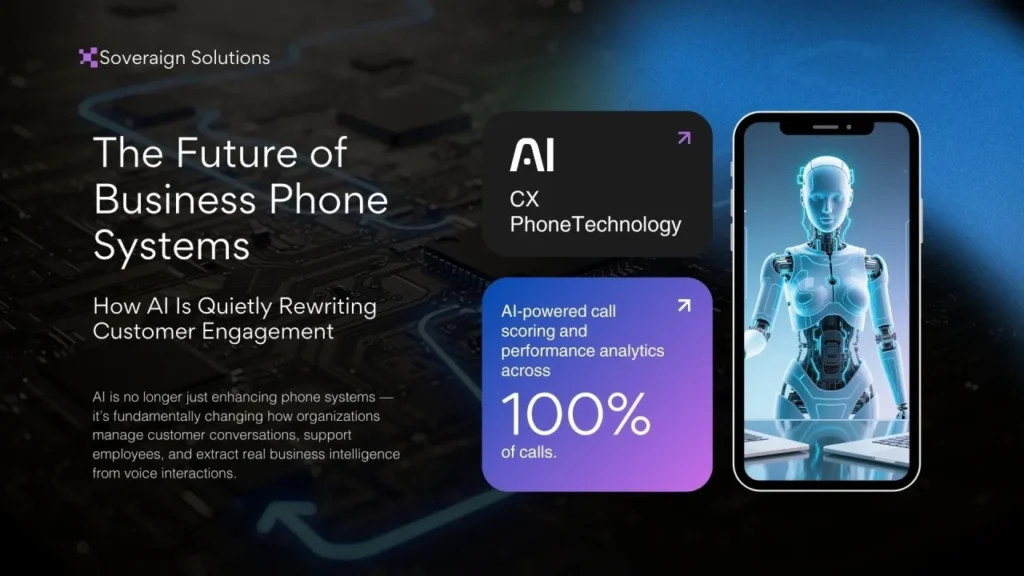
    AI is no longer just enhancing phone systems — it’s fundamentally changing how organizations manage customer conversations, support employees, and extract real business intelligence from voice interactions.

    Recent industry research shows that:

    • Over half of organizations have already integrated AI into phone-based customer conversations

    • Every company using AI to analyze call reports has measurable benefits

    That combination — rapid adoption and universal ROI — is rare in enterprise technology.

    What Leaders Are Actually Using AI Phone Systems For

    The most valuable AI capabilities in modern phone systems aren’t flashy. They’re practical, operational, and measurable.

    Leading organizations are using AI for:

    • Real-time call transcription and automated summaries

    • AI-powered call scoring and performance analytics across 100% of calls

    • Sentiment and intent detection during live conversations

    • Intelligent virtual agents handling routine inbound calls

    • Real-time AI assistance for employees during live customer interactions

    The impact is immediate: shorter wait times, faster resolution, more consistent service — and critically, reduced employee burnout from repetitive or high-pressure calls.

    The Real Breakthrough: Voice Intelligence, Not Just Telephony

    The real shift isn’t replacing phone systems.

    It’s turning them into intelligence platforms.

    Instead of guessing:

    • Why calls escalate

    • Where training gaps exist

    • Which scripts convert

    • Why customers churn

    AI-enabled phone systems provide objective, searchable, and actionable insight across every conversation.

    Organizations using AI-driven voice analytics consistently report:

    • Faster issue resolution

    • Higher customer satisfaction

    • Fewer complaints

    • Better upsell and cross-sell timing

    • Stronger operational consistency

    Phone calls are no longer just conversations — they’re data.

    The Cost of Standing Still

    The research is detailed: delaying AI adoption in phone systems has real consequences.

    Leaders expect organizations that don’t modernize to face:

    • Longer call handling times

    • Higher labor and support costs

    • Lower CSAT and NPS scores

    • Increased customer churn

    • Reduced competitive advantage

    At a time when customers already view long hold times as unacceptable, legacy phone systems are quickly becoming a liability.

    How to Modernize Phone Systems Without Disruption

    Organizations that succeed don’t rush — they execute with discipline.

    The most effective approaches:

    • Tie AI phone initiatives directly to business KPIs (CSAT, AHT, resolution speed)

    • Select AI capabilities based on specific call-related pain points

    • Prepare teams early and address change management head-on

    • Measure outcomes continuously and refine fast

    AI adoption works best when it’s practical, targeted, and measurable.

    Bottom Line

    Business phone systems are no longer just communication tools.

    They are becoming core intelligence infrastructure.

    The winners won’t be the companies that simply “add AI,” but those that turn every phone call into insight, efficiency, and competitive advantage.

    ✅ Cybersecurity trends

    ✅ AI transformation

    ✅ IT strategy for Banking, Financial Services, and Healthcare

  • Your Phone System Is Bleeding Revenue

    Your Phone System Is Bleeding Revenue

    Steven Palange

    CAO CIO CSO & CISSP | Thought Leader | AI Integration & Governance Advisor to CIOs, CISOs, and CFOs Specialist in AI ROI, Risk, Compliance, and AI-Ready

    Every Transfer, every hang-up, every reset is silent revenue walking away.

    Written by Steven Palange, CAO, CIO, CSO, & CISSP | Thought Leader | Helping CXOs & IT Leaders Solve Automation, AI, Cybersecurity, and Cloud with Proven, Scalable Solutions. E:steven_palange@tlic.com P: 401-214-5557

    Special Section: Infographics, Video, & Audio Learning Guide that summarizes this Newsletter Article for Busy Professionals

    🔊Listen to the Strategy Podcast

    🎥Watch the Executive Briefing (Video)

    They Press 1. Then 3. Then 2 Again.

    The caller already wants to hang up.

    Your IVR is technically “working.” But friction is bleeding credibility.

    Missed transfers. Looped menus. No memory. No context.

    And when escalation finally happens, the human agent starts with:

    “How can I help you today?”

    That’s not a voice system. That’s operational amnesia.

    This Was Never a Phone Problem.

    Most organizations are trying to bolt intelligence onto legacy telephony.

    A chatbot layered on top of an IVR. A thin API wrapper pretending to be architecture. A demo that works beautifully — until integration friction surfaces.

    True AI voice isn’t a plugin.

    It’s a layered infrastructure.

    And the stack matters.

    What Actually Sits Behind a Real AI Phone Agent

    1️⃣ Native Enterprise Voice Infrastructure

    Not middleware duct-taped into a PBX. AI embedded inside the business phone system itself — eliminating fragility at the integration layer.

    2️⃣ Generative Reasoning Engine

    Understands intent, nuance, and ambiguity. Not keywords. Not decision trees.

    3️⃣ Retrieval-Augmented Knowledge

    Grounded in your website, FAQs, policies, and uploaded documentation — not hallucinated responses.

    4️⃣ Intelligent Routing

    Routes by name, department, location, or conversational context. No keypad gymnastics.

    5️⃣ Seamless AI-to-Human Handoff

    Transfers with full conversational history and transcript continuity. No reset. No repetition.

    6️⃣ Conversational Intelligence + Analytics

    Resolution rates. Missed intent patterns. Transfer frequency. Operational blind spots you didn’t know existed.

    This is not IVR.

    This is agentic AI embedded inside your voice system.

    The Quiet Cost Most Leaders Ignore

    Receptionist = payroll expense. Missed calls = silent revenue loss.

    That’s the old model.

    The new model?

    AI Receptionist = 24/7 revenue capture + operational intelligence engine.

    Organizations deploying enterprise-grade AI reception architecture report:

    • Up to 50% reduction in inbound handling time • Significant decreases in missed calls • Immediate resolution across a large percentage of inquiries

    That’s not automation.

    That’s capacity creation.

    Before You Approve Any AI Voice Deployment

    Ask this — carefully:

    • Is the AI built directly into the phone infrastructure — or awkwardly layered on top?

    • Is it enterprise-grade and compliant?

    • Does it support seamless AI-to-human escalation?

    • Does it generate transcripts and performance analytics?

    • Can it scale across departments and locations without fragmentation?

    If the answer is no…

    It’s a demo. Not a solution.

    AI Is No Longer a Support Tool

    Voice is just the entry point.

    When properly integrated, AI supports:

    • Intelligent virtual agents

    • Predictive personalization

    • Human productivity amplification

    • Sentiment detection

    • Forecasting and performance analytics

    AI is shifting from a tactical support tool to a core customer lifecycle infrastructure.

    The real question isn’t:

    “Should we deploy AI voice?”

    It’s:

    Is our infrastructure ready for it?

    Experience It.

    Theory is easy. Architecture is harder. Experience is undeniable.

    Call our live AI Phone Agent: 📞 401 227 3451

    Ask us anything about our services. Try to confuse it. See how it routes you.

    Then imagine that capability deployed across your organization, because this isn’t about adding a gadget.

    It’s about upgrading the front door of your business.

  • We Let Our AI Answer 50 Hard Questions About Our Business
    We Let Our AI Answer 50 Hard Questions About Our Business

    Steven Palange

    CAO CIO CSO & CISSP | Thought Leader | AI Integration & Governance Advisor to CIOs, CISOs, and CFOs Specialist in AI ROI, Risk, Compliance, and AI-Ready

    Written by Steven Palange, CAO, CIO, CSO, & CISSP | Thought Leader | Helping CXOs & IT Leaders Solve Automation, AI, Cybersecurity, and Cloud with Proven, Scalable Solutions. E:steven_palange@tlic.com P: 401-214-5557

    Most phone systems can route calls. Ours Can Reason.

    So we tested it.

    We asked our AI Phone Agent 50 real-world questions — the kind actual business owners, IT directors, and security leaders would ask.

    Here’s what happened.

    Special Section

    Want to See All 50?

    We documented every single question we used to stress-test our AI Voice Agent. All 50. From basic service questions… to cybersecurity depth… to AI governance… to real-world interruption scenarios. It’s not a brochure. It’s a live-fire evaluation framework. If you want to see the full list — and use it to test your own systems — Download the complete AI Phone Agent Stress Test (50 Questions) down below:

    Try them.

    Interrupt mid-sentence. Change topics. Simulate a real buyer.

    If your current phone system can survive that… you’re ahead of most businesses.

    Special Section:

    Infographics, Video, & Audio Learning Guide that summarizes this Newsletter Article for Busy Professionals

    🔊Listen to the Strategy Podcast

    🎥Watch the Executive Briefing (Video)

    First, The Basics

    We started simple:

    “What services does Soveraign provide?”

    “How are you different from an IVR?”

    “What’s the ROI of replacing voicemail with AI?”

    The agent didn’t just route.

    It explained:

    • Services clearly

    • Value proposition concisely

    • ROI in business terms

    • And escalated when needed No script reading. No robotic looping.

    Then We Increased the Difficulty

    We interrupted it mid-sentence.

    Changed topics halfway through. Spoke quickly. Asked it to compare EDR vs MDR in 60 seconds.

    Asked it to explain Shadow AI risk to a CFO.

    It adapted. Maintained context.

    Adjusted explanations by audience. Escalated intelligently when required.

    That’s not a phone tree. That’s conversational reasoning.

    Then, We Simulated Real Buyers

    • “I’m an IT Director with 400 users. What should I modernize first?”

    • “I’m a 75-user SMB. Where do I start with AI?”

    “Transfer me to a human and tell them I’m interested in upgrading EDR.”

    It:

    • Identified priorities

    • Framed answers appropriately

    • Logged context

    • Passed structured information to a human

    No repetition. No lost details. No frustration.

    Why This Matters

    Every inbound call is:

    • A revenue opportunity

    • A security discussion

    • A sales lead

    • Or a support request

    Most SMBs still rely on:

    • Voicemail

    • Basic IVR

    • Or whoever happens to answer That’s fragile.

    An AI Voice Agent becomes:

    • 24/7 front desk

    • First-level sales qualifier

    • Technical explainer

    • Escalation router

    • Analytics engine All without adding payroll.

    The Bigger Question

    If your business received 30–100 inbound calls per week:

    • How many are missed?

    • How many go to voicemail?

    • How many aren’t qualified properly?

    • How much context is lost before a human joins?

    Now multiply that by job value.

    This isn’t about AI novelty. It’s about revenue capture discipline.

    If you’re curious what your AI front desk could handle, we’re offering a live demo where you can ask it anything — interrupt it, test it, challenge it.

    We encourage it.

    Because if it can handle 50 hard questions about cybersecurity, AI governance, and SMB modernization…

    It can handle your customers.

    Missed Last Week’s Issue?

    If you haven’t read our previous newsletter on revenue leakage and missed calls, start there.

    It explains why:

    Every missed call is lost revenue.

    And why most businesses don’t measure it.

    WE FIRED THE RECEPTIONIST

    This issue builds on that foundation.

  • Why the CEO Should Be the Rainmaker: The Top Salesperson for Their Company

    Why the CEO Should Be the Rainmaker: The Top Salesperson for Their Company

    In today’s competitive business environment, the CEO should be the top salesperson to leverage their unique advantages and drive the company’s success.

    Visionary Leadership: As the strategic leader, the CEO can communicate the company’s vision, mission, and values to potential customers, enhancing the value proposition.

    Credibility and Authority: Pro1spects view the CEO as the face of the company, which lends authority and credibility to sales pitches, fostering trust and making it easier to close deals.

    Strategic Networking: The CEO’s extensive network can open doors to valuable opportunities inaccessible to other sales team members.

    Agility in Decision-Making: As the top decision-maker, the CEO can swiftly address customer concerns, negotiate terms, and approve deals, ensuring a smoother sales process.

    Structured Workflow: A structured workflow helps the CEO balance responsibilities, including strategic planning, customer engagement, internal coordination, strategic selling, and review and reflection.

    Morning Routine: The CEO should start the day with strategic planning and networking, reviewing key sales metrics, and connecting with industry contacts.

    Customer Engagement: Mid-morning should be dedicated to client meetings and timely follow-ups to discuss needs, present solutions, and build relationships.

    Internal Coordination: Late morning involves syncing with the sales team and collaborating with other departments to align customer needs and feedback.

    Strategic Selling: Afternoons should focus on crafting high-value proposals and negotiating to close deals.

    Thought Leadership: The CEO should engage in thought leadership activities such as industry conferences, writing articles, and public speaking to establish the company as an industry leader.

    In today’s competitive business landscape, the CEO must become the rainmaker, acting as the foremost salesperson for the company. This unique position offers several advantages that can significantly impact the company’s success.

    I. The Unique Advantages of a CEO as a Rainmaker:

    1. Visionary Leadership: As the strategic leader, the CEO has a comprehensive understanding of the company’s vision, mission, and values. This deep knowledge enables them to communicate the company’s unique value proposition effectively to potential customers and prospects.

    2. Credibility and Authority: Prospects often view the CEO as the face of the company, lending an air of authority and credibility to sales pitches. This can foster trust and confidence, making it easier to close deals.

    3. Strategic Networking: The CEO’s extensive network of contacts can open doors inaccessible to other sales team members. Their relationships with industry leaders, influencers, and decision-makers can lead to valuable opportunities.

    4. Agility in Decision-Making: As the top decision-maker, the CEO can swiftly address customer concerns, negotiate terms, and approve deals, ensuring a smoother and faster sales process.

    II. Workflow and Processes for the CEO as a Rainmaker:

    The CEO should implement a structured workflow and processes to balance their responsibilities as CEO and top salesperson effectively. Here’s a detailed breakdown of the daily tasks and strategies they should incorporate:

    1. Morning Routine: Strategic Planning and Networking

    • Daily Briefing: Review key sales metrics, pipeline status, and any pressing issues from the previous day.
    • Networking: Allocate time to connect with key industry contacts and attend networking events or virtual meetings.

    2. Mid-Morning: Customer Engagement

    • Client Meetings: Schedule meetings with top prospects and existing customers to discuss their needs, present solutions, and build relationships.
    • Follow-Up: Ensure timely follow-up on all client interactions, responding promptly to emails, calls, and inquiries.

    3. Late Morning: Internal Coordination

    • Sales Team Sync: Hold briefings with the sales team to align strategy, share insights, and address any roadblocks.
    • Cross-Departmental Meetings: Collaborate with marketing, product development, and customer support to ensure alignment of customer needs and feedback.

    4. Afternoon: Strategic Selling

    • High-Value Proposals: Focus on crafting and delivering high-value proposals to key prospects.
    • Negotiations: Engage with potential clients, leveraging the CEO’s authority to finalize terms and close deals.

    5. Evening: Review and Reflect

    • Daily Wrap-Up: Review the day’s activities, assess progress toward sales goals, and plan for the following day.
    • Learning and Development: Stay updated on industry trends, competitor activities, and sales techniques.

    6. Ongoing Activities:

    • Thought Leadership: Participate in industry conferences, write articles, and engage in public speaking to establish the company as a leader in the field.
    • Customer Relationship Management (CRM): Utilize CRM tools to track interactions, manage the sales pipeline, and analyze customer data for insights.

    By adopting these workflows and processes, the CEO can effectively fulfill their role as the company’s top salesperson, driving growth and fostering strong, lasting customer relationships. This proactive approach boosts sales and ensures the company’s strategic vision is consistently communicated and realized in the marketplace.

    III. Why the CEO Should Be the Rainmaker: The Top Salesperson for Their Company

    In today’s competitive business landscape, the CEO must become the rainmaker, acting as the foremost salesperson for the company. This unique position offers several advantages that can significantly impact the company’s success.

    IV. The Unique Advantages of a CEO as a Rainmaker:

    1. Visionary Leadership: As the strategic leader, the CEO has a comprehensive understanding of the company’s vision, mission, and values. This deep knowledge enables them to communicate the company’s unique value proposition effectively to potential customers and prospects.

    2. Credibility and Authority: Prospects often view the CEO as the face of the company, lending an air of authority and credibility to sales pitches. This can foster trust and confidence, making it easier to close deals.

    3. Strategic Networking: The CEO’s extensive network of contacts can open doors inaccessible to other sales team members. Their relationships with industry leaders, influencers, and decision-makers can lead to valuable opportunities.

    4. Agility in Decision-Making: As the top decision-maker, the CEO can swiftly address customer concerns, negotiate terms, and approve deals, ensuring a smoother and faster sales process.

    V. Workflow and Processes for the CEO as a Rainmaker:

    The CEO should implement a structured workflow and processes to balance their responsibilities as CEO and top salesperson effectively. Here’s a detailed breakdown of the daily tasks and strategies they should incorporate:

    1. Morning Routine: Strategic Planning and Networking

    • Daily Briefing: Review key sales metrics, pipeline status, and any pressing issues from the previous day.
    • Networking: Allocate time to connect with key industry contacts and attend networking events or virtual meetings.

    2. Mid-Morning: Customer Engagement

    • Client Meetings: Schedule meetings with top prospects and existing customers to discuss their needs, present solutions, and build relationships.
    • Follow-Up: Ensure timely follow-up on all client interactions, responding promptly to emails, calls, and inquiries.

    3. Late Morning: Internal Coordination

    • Sales Team Sync: Hold briefings with the sales team to align on strategy, share insights, and address any roadblocks.
    • Cross-Departmental Meetings: Collaborate with marketing, product development, and customer support to ensure alignment of customer needs and feedback.

    4. Afternoon: Strategic Selling

    • High-Value Proposals: Focus on crafting and delivering high-value proposals to key prospects.
    • Negotiations: Engage with potential clients, leveraging the CEO’s authority to finalize terms and close deals.

    5. Evening: Review and Reflect

    • Daily Wrap-Up: Review the day’s activities, assess progress toward sales goals, and plan for the following day.
    • Learning and Development: Stay updated on industry trends, competitor activities, and new sales techniques.

    6. Ongoing Activities:

    • Thought Leadership: Participate in industry conferences, write articles, and engage in public speaking to establish the company as a leader in the field.
    • Customer Relationship Management (CRM): Utilize CRM tools to track interactions, manage the sales pipeline, and analyze customer data for insights.

    VI. Target Contacts for CEOs from Hospitals, Banks, and Top Organizations:

    1. Hospitals:

    • Hospital Administrators and CEOs: Engage with leaders of other hospitals to discuss potential collaborations or service offerings.
    • Insurance Company Executives: Build relationships with top insurance companies to negotiate better rates and partnerships.
    • Medical Device and Pharmaceutical Executives: Connect with suppliers to ensure the best products and innovations are accessible.
    • Healthcare Consultants: Network with industry experts to gain insights and explore opportunities for improvement and growth.

    2. Banks:

    • Corporate Clients: Reach out to CFOs and CEOs of large corporations to offer banking and financial services.
    • Investment Firms: Connect with top executives to discuss potential partnerships or investment opportunities.

    VII. Regulatory Authorities: Dialogue with key figures in regulatory bodies to stay ahead of compliance requirements and industry changes.

    • Fintech Companies: Explore partnerships with innovators to integrate new technologies and enhance service offerings.

    3. Top Organizations:

    • Fortune 500 Company Executives: Target C-suite executives to propose strategic partnerships or solutions that add value.
    • Government Officials: Engage with policymakers and government leaders to influence and stay informed about regulations that may impact the industry.
    • Industry Influencers: Build relationships with thought leaders and influencers to enhance brand reputation and reach.
    • Significant Clients and Partners: Regularly communicate with key clients and partners to ensure satisfaction and explore new business opportunities.

    By adopting these workflows and targeting the right contacts, the CEO can effectively fulfill their role as the company’s top salesperson, driving growth and fostering strong, lasting customer relationships.

    This proactive approach boosts sales and ensures the company’s strategic vision is consistently communicated and realized in the marketplace.

    Please contact us at sales@tlic.com to hire a skilled Filipino virtual IT professional and let us tailor a solution that best suits your business needs.

    Or, schedule a Call with me:

  • Transform Your IT Operations with Filipino Virtual Professionals from Soveraign Solutions
    Transform Your IT Operations with Filipino Virtual Professionals from Soveraign Solutions

    In today’s fast-paced business environment, staying competitive means optimizing operations while keeping costs under control. One increasingly popular strategy is outsourcing IT functions to virtual professionals.

    At Soveraign Solutions, we offer highly skilled Filipino virtual IT professionals for as low as $500 for 20 hours per month, tailored to your specific needs.

    To also ensure we provide the best talent, we source our Filipino IT professionals from reputable platforms and organizations, including Upwork and key IT associations in the Philippines:

    1. Information Technology and Business Process Association of the Philippines (IBPAP)
    • This association supports the growth of the IT and business process management sector through industry representation, knowledge sharing, and professional development.

    2. National ICT Confederation of the Philippines (NICP)

    • NICP collaborates with local ICT councils to promote the ICT sector and create jobs.

    3. Philippine Computer Society (PCS)

    • PCS fosters the sharing of knowledge and best practices among IT professionals and promotes professional development.

    4. Philippine Software Industry Association (PSIA)

    • PSIA promotes the Philippines as a preferred choice for software development services and partners with government institutions for training and development.

    5. Philippine Society of Information Technology Educators (PSITE)

    • PSITE supports IT education and practice, focusing on academics and teachers in the field.

    Why should your business consider this option, and how do we approach and mitigate potential issues?

    1. Cost Efficiency

    Hiring a Filipino virtual IT professional provides substantial cost savings. For only $500 per month, businesses can access top-tier IT talent without the high costs associated with local hires. This budget-friendly solution allows companies to reallocate resources more effectively, reducing overhead expenses such as office space, equipment, and employee benefits. By outsourcing, you can achieve more with less and invest in other critical areas of your business.

    2. High-Quality Talent

    The Philippines is renowned for its highly educated and experienced IT professionals. Our virtual IT team consists of experts who have successfully completed numerous projects for clients worldwide. These professionals bring a wealth of knowledge and a strong work ethic, ensuring that your IT needs are met with the highest standards of quality and reliability.

    3. Flexibility

    At Soveraign Solutions, we understand that every business has unique requirements. Our flexible service model allows you to choose the number of hours and specific services you need. Whether it’s for routine maintenance or major projects, we tailor our services to fit your business demands. This scalability ensures you only pay for what you need, providing exceptional value.

    4. Time Zone Advantages

    Having a team in a different time zone can offer significant benefits. With our Filipino IT professionals, you gain the advantage of extended business hours and around-the-clock support. This means faster issue resolution, increased productivity, and a seamless workflow that keeps your business running smoothly at all times.

    Addressing Potential Issues

    1. Communication Barriers

    Effective communication is crucial in any business relationship. Our team members are proficient in English and trained in best communication practices to ensure clear and efficient interactions. We also employ state-of-the-art communication tools and protocols to facilitate smooth collaboration between your team and ours.

    2. Security Concerns

    Data security is a top priority at Soveraign Solutions. We implement robust security measures, including encryption, secure access protocols, and regular security audits to protect your sensitive information. Our commitment to data protection is underscored by our adherence to industry-standard certifications and compliance regulations.

    3. Quality Control

    Maintaining high standards of quality is at the core of our services. We have established rigorous monitoring and quality assurance processes to ensure that our virtual IT professionals deliver consistent, top-notch performance. Client testimonials and case studies further demonstrate our commitment to excellence and client satisfaction.

    4. Cultural Differences

    Navigating cultural differences can be a challenge, but our team is well-prepared. We provide cultural training to our staff to ensure they understand and align with US business practices. This training, coupled with their professional experience, allows them to seamlessly integrate into your business environment.

    Hiring a Filipino virtual IT professional from Soveraign Solutions offers a cost-effective, flexible, and high-quality solution to meet your IT needs. By addressing potential risks through robust communication, security, and quality control measures, we ensure a smooth and successful partnership.


  • Who owns AI – IT, Sales, and Marketing? Data Analytics or the C-Suite?

    Who owns AI – IT, Sales, and Marketing? Data Analytics or the C-Suite?


    Artificial Intelligence (AI) has become a pivotal tool across various departments in today’s rapidly evolving business landscape. This brings up a crucial question:

    Who owns AI within an organization? Is it the domain of IT that is responsible for the technological infrastructure?

    -Or does it belong to sales and marketing, which leverages AI for customer insights and targeted campaigns? Perhaps HR, which uses AI for recruitment and employee engagement, should have ownership.

    -Or is it Data Analytics, with its deep involvement in data-driven decision-making?

    Finally, could the C-Suite, responsible for overarching strategic decisions, be the rightful owner?

    Consider the following aspects when forming your response:

    1. Role and Responsibilities: What are the primary responsibilities of each department regarding AI implementation and management?

    2. Collaboration and Integration: How do these departments collaborate in the context of AI? Can AI ownership be shared, or does it need centralized authority?

    3. Strategic Importance: Which department most effectively aligns AI initiatives with the organization’s overall strategic goals?

    4. Resource Allocation and Expertise: Who has the necessary resources and expertise to manage AI projects?

    Discuss the potential advantages and disadvantages of each department owning AI and propose an optimal ownership model to benefit the organization.

    Role and Responsibilities:

    • IT: Responsible for the technological infrastructure, ensuring AI systems are secure, scalable, and integrated with existing technologies.
    • Sales and Marketing: Leverages AI for customer insights, personalized marketing campaigns, and enhancing customer experiences.
    • HR: Uses A I for recruitment, talent management, employee engagement, and training programs.
    • Data Analytics: Focuses on data-driven decision-making, analyzing data, and creating predictive models to drive business strategy.
    • C-Suite: Oversees strategic decision-making, ensuring AI initiatives align with the company’s long-term vision and goals.

    Collaboration and Integration:

    • Departments must collaborate closely to ensure that AI tools are effectively integrated and leveraged across the organization.
    • A shared ownership model could foster collaboration, with a centralized authority (such as a Chief AI Officer) coordinating efforts.

    Strategic Importance:

    • Ensures AI systems are technically sound.
    • Sales and marketing drive revenue through AI-enhanced strategies.
    • HR focuses on optimizing workforce management.
    • Data Analytics ensures data integrity and insightful decision-making.
    • The C-Suite aligns AI projects with strategic goals.

    Resource Allocation and Expertise:

    • IT: Technological expertise and infrastructure management.
    • Sales and Marketing: Market knowledge and customer engagement strategies.
    • HR: Understanding recruitment and employee development needs.
    • Data Analytics: Expertise in data analysis and predictive modeling.
    • C-Suite: Strategic oversight and resource allocation capabilities.

    Advantages and Disadvantages of Departmental Ownership:

    -IT:

    • Advantages: Strong technical foundation, security, and integration.
    • Disadvantages: It may lack business context and strategic focus.
    • Sales and Marketing:
    • Advantages: Direct impact on revenue and customer engagement.
    • Disadvantages: May lack technical expertise and broader organizational perspective.

    – HR:

    • Advantages: Enhanced recruitment and employee management.
    • Disadvantages: Limited impact on overall business strategy.

    -Data Analytics:

    • Advantages: Data-driven insights and decision-making.
    • Disadvantages: May lack the practical application of insights across all departments.

    – C-Suite:

    • Advantages: Holistic view of organizational strategy and resource allocation.
    • Disadvantages: May not have hands-on expertise in AI implementation.

    Optimal Ownership Model:

    • A hybrid model where a centralized AI team (led by a Chief AI Officer) coordinates AI initiatives across departments.
    • Departments retain specific AI responsibilities relevant to their functions, with collaboration and integration facilitated by the central AI team.
    • The C-Suite ensures AI initiatives align with strategic goals and allocates resources as needed.

    This model balances technical expertise, strategic alignment, and effective collaboration, ensuring AI initiatives drive overall organizational success.

  • Why Neglecting Your Application Configuration is a Big Mistake—and How Sovereign Solutions Can Help
    Why Neglecting Your Application Configuration is a Big Mistake—and How Sovereign Solutions Can Help

    In today’s fast-paced digital landscape, ensuring that applications are configured correctly is paramount for achieving optimal performance and robust security. Configuration management goes beyond initial setup; it requires continuous monitoring and adjustment to adapt to evolving demands and threats. This blog explores the significance of active configuration management and provides actionable insights for IT professionals and developers.

    The Critical Role of Configuration Management in Maintaining Application Performance and Security

    Configuration management is vital for maintaining the performance and security of applications. Proper configuration ensures that applications use resources efficiently, avoid conflicts, and comply with security policies. Conversely, misconfigurations can lead to performance degradation, security vulnerabilities, and system outages.

    1. Performance Optimization: Ensures optimal resource utilization and reduces latency.

    2. Security Assurance: Enforces security policies, preventing unauthorized access and data breaches.

    3. Compliance: Helps adhere to industry standards and regulations.

    The Importance of Expert Third-Party Audits

    To ensure that configurations are optimized and secure, it is crucial to have an expert third party audit your application configurations. Third-party audits provide an unbiased review of your systems, uncovering hidden vulnerabilities and inefficiencies that internal teams might overlook. These audits help validate that your configurations adhere to best practices and compliance requirements and can offer recommendations for improvements.

    Why Soveraign Solutions is the Ideal Third-Party

    Due to its extensive expertise and comprehensive approach, Soveraign Solutions is the ideal third-party auditor for application configurations. With over 30 years of experience in managed services, SOC, and data center solutions, Soveraign Solutions offers unparalleled knowledge in AI-driven security and productivity. Their team of offshore Filipino experts is adept at continuously monitoring and managing security applications, ensuring that configurations are always aligned with the latest industry standards and threats. By partnering with Soveraign Solutions, organizations can benefit from tailored services that enhance security and productivity.

    Common Challenges in Configuration Management

    Despite its importance, configuration management comes with several challenges:

    1. Complexity: Modern applications have numerous interdependencies.

    2. Dynamic Environments: Cloud and microservices architectures introduce constant changes.

    3. Human Error: Manual configurations are prone to errors.

    4. Inconsistent Practices: Lack of standardized procedures can lead to discrepancies.

    Best Practices for Monitoring Application Configurations

    Effective configuration management requires robust monitoring practices:

    1. Automated Tools: Utilize tools like Puppet, Chef, or Ansible for automation.

    2. Version Control: Keep configurations under version control to track changes.

    3. Regular Audits: Conduct periodic reviews to ensure compliance and identify issues.

    4. Centralized Management: Use centralized platforms to manage configurations across environments.

    The Dual Role of Alerts in Configuration Management

    Alerts play a crucial role in configuration management, serving two primary functions:

    1. For Rapid Triage of Configuration-Related Issues
    • Immediate alerts help quickly identify and address configuration-related problems, minimizing downtime and performance issues.

    2. For Identifying Areas Where Configuration Can Be Hardened or Optimized

    • Alerts also provide insights into potential areas for improvement, enabling proactive hardening and optimization of configurations to enhance performance and security.

    Real-world examples of Proper Configuration Monitoring and Management

    Case Study 1: Preventing Downtime

    A leading e-commerce platform avoided significant downtime during peak sales by using automated configuration monitoring. Alerts identified a misconfiguration in their database cluster, allowing the IT team to rectify the issue before it escalated.

    Case Study 2:Enhancing Security

    A financial institution improved its security posture by implementing configuration management tools. Continuous monitoring and automated alerts detected unauthorized configuration changes, preventing potential data breaches.

    Tools and Techniques for Effective Configuration Monitoring and Alerting

    Several tools and techniques can enhance configuration monitoring and alerting:

    1. Prometheus and Grafana: For real-time monitoring and visualization.

    2. ELK Stack: For centralized logging and alerting.

    3. Terraform: For managing infrastructure as code.

    4. Nagios: For comprehensive monitoring and alerting.

    5. CI/CD Pipelines: Integrate configuration checks into continuous integration and deployment pipelines.

    6. Integrating Configuration Managementinto DevOps or SRE Practices

    Configuration management should be seamlessly integrated into DevOps and SRE practices:

    1. Infrastructure as Code (IaC): Use IaC to automate and standardize configurations.

    2. Continuous Monitoring: Implement continuous monitoring to detect and respond to changes.

    3. Collaboration: Collaborate with development and operations teams for consistent configuration management.

    4. Feedback Loops: Establish feedback loops to improve configuration practices continuously.

    Conclusion

    Active configuration management is essential for maintaining application performance and security. IT professionals and developers can ensure their applications remain robust and efficient by understanding their critical role, addressing common challenges, following best practices, and leveraging the right tools. Integrating configuration management into DevOps or SRE practices further enhances these benefits, fostering a culture of continuous improvement and resilience.

    Configuration management is not a one-time task but an ongoing process that requires vigilance, expertise, and the correct set of tools.

    By embracing these practices and partnering with expert third-party auditors like Soveraign Solutions, organizations can navigate the complexities of modern IT environments and achieve their performance and security goals.

    Choosing Sovereign Solutions means securing your future with confidence. Your app’s configuration matters. Contact us today to partner with experts dedicated to safeguarding your digital assets and reputation.”

    Don’t wait—act now and protect your organization with Sovereign Solutions!

    Thanks for Reading!

    Hold on a second! You should get my articles sent straight to your newsfeed. Subscribe here to stay updated and ahead in technology with your business.

    Book a time to meet with me.

    Subscribe to “AI for Security & Productivity

    View my LinkedIn Posts to Audit my Security Expertise

  • Framework Basics: CIS-20 SafeGuards 1 & 2

    Framework Basics: CIS-20 SafeGuards 1 & 2

    “In today’s digital landscape, securing your organization starts with knowing what’s in your network. CIS Control 1 emphasizes the importance of inventory and control of enterprise assets, ensuring you can protect what you know you have. Let’s break it down.”

    Utilize an active discovery tool to identify all assets connected to the network. This means continuously scanning and updating your inventory to catch every device, authorized or not.

    Deploy a passive asset discovery tool. This safeguard complements active discovery by monitoring network traffic and identifying devices without active scans, ensuring no asset goes unnoticed.

    At Soveraign Solutions, we excel in software licensing and management, which is crucial for maintaining these controls. Our tailored solutions ensure you have the right tools to monitor your network actively and passively. With over 30 years of experience and a team of offshore experts from the Philippines, we provide continuous, AI-driven security management that evolves with the threat landscape.

    Don’t leave your network security to chance. Partner with Soveraign Solutions, where our expertise in software licensing helps you achieve CIS Control 1, Safeguards 1, and 2, ensuring your assets are always accounted for and protected.

    Soveraign Solutions. Protecting your digital future.

    Thanks for Reading!

    Hold on a second! You should get my articles sent straight to your newsfeed. Subscribe here to stay updated and ahead in technology with your business.

    Book a time to meet with me.

    Subscribe to “AI for Security & Productivity

    View my LinkedIn Posts to Audit my Security Expertise